Ditapis dengan
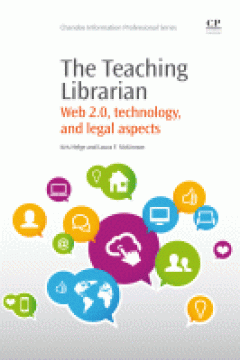
The Teaching librarian : web 2.0, technology, and legal aspects
Librarians need to utilize web 2.0 tools to generate rich-text learning environments, creating enriching, challenging, and supportive learning platforms for students. The Teaching Librarian shows how to utilize wikis, mindmaps, and Second Life to improve pedagogy for librarians. This title covers how to obtain administration approval to implement web 2.0 tools, how to deal with and prevent tech…
- Edisi
- -
- ISBN/ISSN
- 9781843347330
- Deskripsi Fisik
- xiii, 181 hlm.
- Judul Seri
- Chandos Information Professional Series
- No. Panggil
- E1375

Achieving transformational change in academic libraries
Academic libraries undergo episodes of strategic change. Transformational change may be seen as fundamentally different from other kinds of change. A part of this process is often deep level cultural change. At the individual level this may be traumatic, but at the strategic level, such change can prove essential.Achieving Transformational Change in Academic Libraries explores the purpose and n…
- Edisi
- -
- ISBN/ISSN
- 9781843347248
- Deskripsi Fisik
- xix, 197 hlm.
- Judul Seri
- Chandos Information Professional Series
- No. Panggil
- E1374

Trends, discovery, and people in the digital age
Digital information is a constantly developing field. The first title in the Chandos Digital Information Review series, Trends, Discovery, and People in the Digital Age, summarises and presents key themes, advances and trends in all aspects of digital information today, exploring the impact of developing technologies on the information world. This book emphasises important contemporary topics a…
- Edisi
- -
- ISBN/ISSN
- 9781843347231
- Deskripsi Fisik
- -
- Judul Seri
- Chandos Digital Information Review
- No. Panggil
- E1373

Digital libraries : from technology to culture
No Inv.: 116872/P/Perp/09/1c
- Edisi
- -
- ISBN/ISSN
- 8173918597
- Deskripsi Fisik
- xviii, 391 hlm.
- Judul Seri
- -
- No. Panggil
- 025.524 DIG

Multimedia information retrieval : theory and techniques
Novel processing and searching tools for the management of new multimedia documents have developed. Multimedia Information Retrieval (MIR) is an organic system made up of Text Retrieval (TR); Visual Retrieval (VR); Video Retrieval (VDR); and Audio Retrieval (AR) systems. So that each type of digital document may be analysed and searched by the elements of language appropriate to its nature, sea…
- Edisi
- -
- ISBN/ISSN
- 9781843347224
- Deskripsi Fisik
- xxxi, 343 hlm.
- Judul Seri
- Chandos Information Professional Series
- No. Panggil
- E1372
Competencies for science librarians
No Inv.: 123822/P/Perp/10/1c
- Edisi
- -
- ISBN/ISSN
- 9780789037305
- Deskripsi Fisik
- ix, 199 hlm.
- Judul Seri
- -
- No. Panggil
- 025 COM
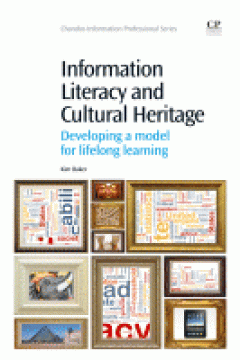
Information literacy and cultural heritage : developing a model for lifelong …
There is a complex and contested terrain of cultural heritage in the library, archive and museum context. Information Literacy and Cultural Heritage explores this landscape and covers perspectives from museums, archives and libraries, highlighting the role of memory and contested history in the collection, description and presentation of cultural heritage. The book argues that the convergence o…
- Edisi
- -
- ISBN/ISSN
- 9781843347200
- Deskripsi Fisik
- xxvii, 198 hlm.
- Judul Seri
- Chandos Information Professional Series
- No. Panggil
- E1371
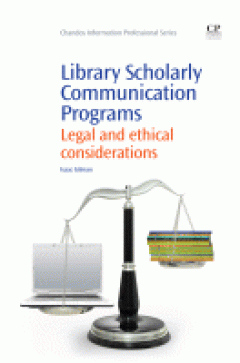
Library scholarly communication programs : legal and ethical considerations
Libraries must negotiate a range of legal issues, policies and ethical guidelines when developing scholarly communication initiatives. Library Scholarly Communication Programs is a practical primer, covering these issues for institutional repository managers, library administrators, and other staff involved in library-based repository and publishing services. The title is composed of four parts…
- Edisi
- -
- ISBN/ISSN
- 9781843347170
- Deskripsi Fisik
- xvii, 293 hlm.
- Judul Seri
- Chandos Information Professional Series
- No. Panggil
- E1369
An introduction to staff development in academic libraries
No Inv.: 123897-123898/P/Perp/10/2c~129892/PSM/Perp/11/1c
- Edisi
- -
- ISBN/ISSN
- 9780789038456
- Deskripsi Fisik
- xiii, 233 hlm.
- Judul Seri
- -
- No. Panggil
- 020.715 5 INT
Libraries designed for kids
No Inv.: 123844/P/perp/10/1c~129887/PSM/Perp/11/1c
- Edisi
- -
- ISBN/ISSN
- 9781856046572
- Deskripsi Fisik
- ix, 173 hlm.
- Judul Seri
- -
- No. Panggil
- 721.8 LUS l
 Karya Umum
  Filsafat
  Agama
Agama  Ilmu-ilmu Sosial
  Bahasa
  Ilmu-ilmu Murni
  Ilmu-ilmu Terapan
  Kesenian, Hiburan, dan Olahraga
  Kesusastraan
  Geografi dan Sejarah